
Give your Make scenarios clean fields to work with
Make routes your data. Parseur decides what the data is. Parseur is the AI email parser for Make that reads email bodies, PDF attachments, and scanned documents, then fires the webhook that starts your scenario with named fields instead of raw text. Make's built-in parser matches regex patterns. Parseur understands the document.
-
PDF and scanned attachments
Parseur extracts supplier, dates, totals, and line items from PDFs and scans that arrive by email, then passes each field to Make. The built-in Email and Text Parser module cannot open an attachment at all.
-
Multi-branch routing from one email
Parseur sends one structured payload per document, so a single Make scenario can branch it into a spreadsheet row, a CRM record, and a Slack message without parsing anything twice.
-
Repeating rows and line items
Parseur splits repeating tables such as invoice line items into separate objects, so Make can iterate over them instead of wrestling a single blob of text apart.
How the Make integration works
-
1. Create your Parseur mailbox
- Sign up and get a dedicated email address where your documents land.
-
2. Forward your emails
- Send emails manually or set up auto forwarding so every new one arrives on its own.
-
3. AI extracts the data
- Parseur reads each email and pulls out the fields you need as structured data.
-
4. Data lands in Make
- Parseur pushes the parsed data straight to Make in real time with the native integration.

What is Parseur?
Parseur is a powerful document processing software to extract text from emails, PDFs and documents and automate your workflow. All Parseur features.

What is Make?
Make is a no-code automation platform for building workflows and integrating applications together. It lets you design complex multi-step automations using a visual drag-and-drop interface with no coding required.
Trusted for Make workflows in production
Emonkey builds API integrations for accounting systems across Scandinavia on an OEM platform running on Make. Its clients send flat files by email, Parseur extracts the data and triggers the Make scenarios by webhook, exactly the shape this integration describes. Founder Piet Deprez moved to Parseur after Gmail aliases left him with no webhook to trigger anything.
- Downtime across Emonkey's years running Parseur in production
- 0
- Documents processed by Parseur since 2016
- 100M+
- Parseur rating on Capterra and GetApp
- 5/5
Make is one of the most capable automation platforms available, but it has a limitation that catches teams by surprise: its built-in email parser relies on regex patterns and fixed text positions. When a sender reformats their email, the extraction breaks. And if the data is inside a PDF attachment, Make's built-in parser can't touch it at all.
Pairing Make with Parseur fixes that. Parseur's AI email parser extracts structured data from emails and PDFs regardless of layout, then sends the clean results to Make as a trigger. Make takes it from there, routing the data to any of the thousands of apps in its library.
Key Takeaways
- Parseur extracts structured data from emails and PDFs using AI, then sends it to Make as a trigger for your automation scenarios.
- Make's built-in email parser works for simple, stable text-based emails. Parseur handles varying layouts, PDF attachments, and scanned documents that Make alone can't process.
- One parsed email can trigger a Make scenario that simultaneously updates multiple apps: a spreadsheet, a CRM, a Slack channel.
- No coding is required on either side. Parseur is a no-code extractor and Make is a visual workflow builder.
- Both have free plans, so you can test the full integration before committing.
Why use Parseur with Make instead of Make's built-in email parser?
Make includes an Email and Text Parser module that pulls data from emails using regex. It's quick to set up for simple cases. The problems show up when email formats change or when the data you need is inside a PDF attachment.
Make's built-in parser can't:
- Handle PDF or image attachments
- Process scanned documents (there's no OCR)
- Adapt when a sender changes their email layout
- Extract table rows like invoice line items as separate structured objects
Parseur fills those gaps. It uses AI to understand what the data means rather than where it sits on the page, so it keeps working when layouts shift. Add it as the trigger in your Make scenario and you get a resilient extraction layer in front of all your automation logic.
What you can build with Parseur and Make
Teams use this combination to automate document-heavy workflows across every department:
- Lead capture: Contact form notification emails land in Parseur, which extracts name, email, company, and message, then triggers a Make scenario that creates a contact in HubSpot or another CRM and sends a Slack alert to the sales team. See the lead email guide.
- Invoice processing: Supplier invoice PDFs arrive by email. Parseur extracts vendor, amount, due date, and line items, then Make routes the data to accounting software and logs the invoice in a tracking spreadsheet. See the invoice processing guide.
- Order management: E-commerce order confirmation emails are parsed and routed to a fulfillment sheet and a notification channel at the same time.
- Content monitoring: Google Alerts digest emails are parsed and filtered in Make, with matching articles added to a Notion database or Airtable board automatically.
- Real estate and job workflows: Property listing alerts and job application notifications are parsed and routed into tracking sheets or CRMs as each email arrives.
How the integration works
The setup has three moving parts:
- A new email or PDF arrives in your Parseur mailbox
- Parseur extracts the structured data fields you defined and sends the results to Make via webhook
- Make runs your scenario, routing the data to whichever apps you've connected
You configure the extraction in Parseur and the routing logic in Make. After that, the two tools talk to each other automatically. This trigger is one of Parseur's real-time exports, so your scenario fires the moment a document finishes processing.

Step-by-step: Set up Parseur with Make
The example below uses Google Alerts emails parsed into a Notion database, but the same steps apply to any document type and any Make-connected app.

Step 1: Forward your documents to Parseur
Each Parseur mailbox has a dedicated email address. Forward a sample email to it, or set up an auto-forwarding rule in Gmail or Outlook so that every new matching email goes to Parseur automatically.
The email appears in your mailbox within seconds, including any PDF or image attachments.
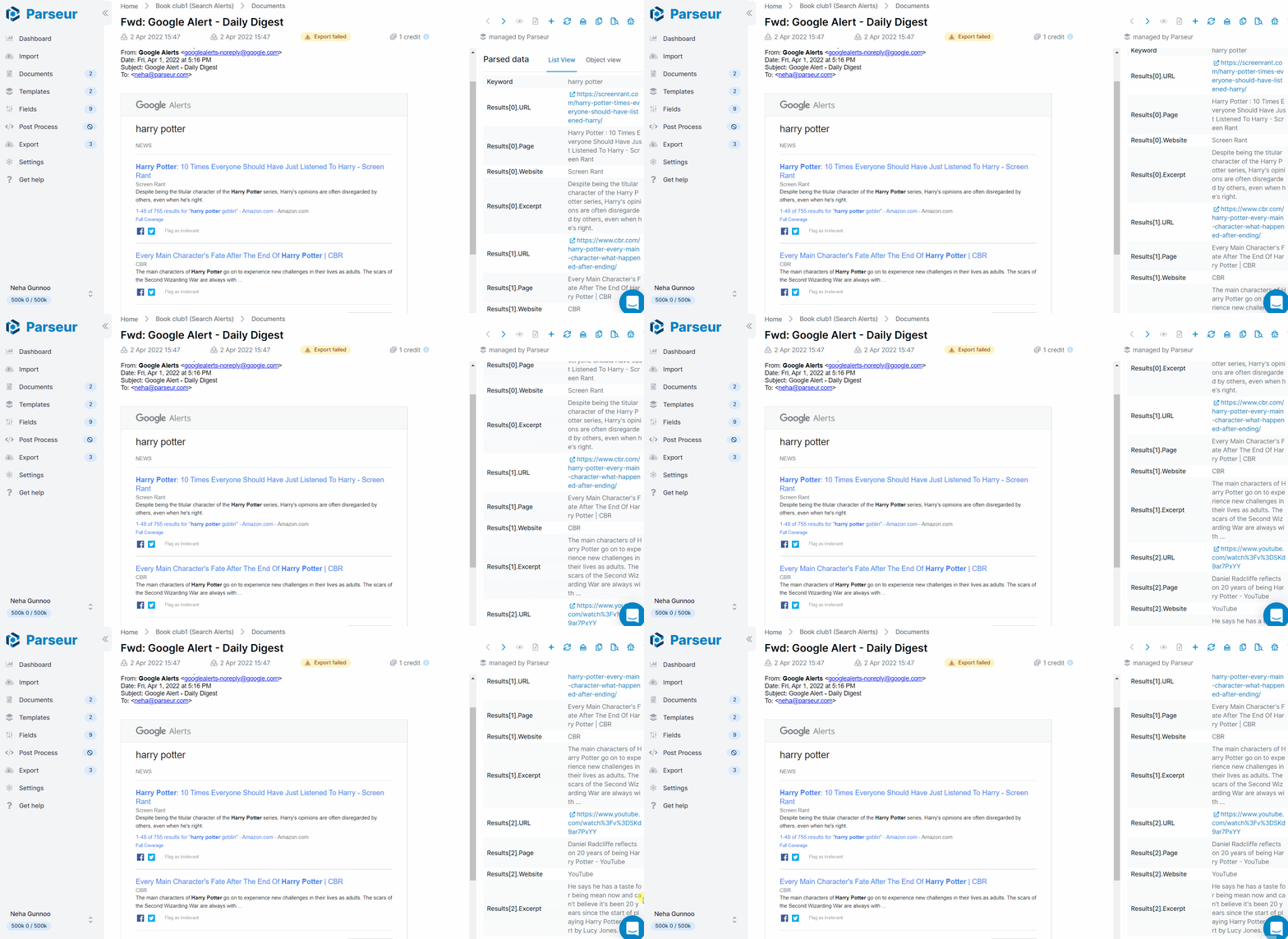
Step 2: Parseur extracts the data
For Google Alerts and other supported formats, Parseur's AI processes the email automatically using its pre-built template.
For custom document types, you define a template by highlighting the data you want to capture and naming each field. Parseur applies that logic to every future document of the same type.
Parseur also handles complex formats like real estate listings, food ordering confirmations, and job search alerts, reading each one by meaning instead of by a template.
Step 3: Connect Parseur to Make
In Parseur, go to Export, then Make, then New Scenario. This opens Make with Parseur already added as the trigger module.

In Make, add your Parseur connection and API key (found under your Parseur account settings), then select the mailbox you want to use as the data source.

Make generates a webhook URL. Copy it and paste it into Parseur under Export, then Webhook, then New Webhook. The connection appears as active under Make.

Step 4: Add your action modules in Make
Click (+) in Make to add the next module in your scenario. Search for the app you want to send data to, connect your account, and map the Parseur fields to the correct inputs.
For the Google Alerts to Notion example: add Notion as the action module, select your database, and map each Parseur field (title, URL, source, date) to the corresponding Notion property.

If it's your first time connecting Notion to Make, you'll be prompted to grant access.
Step 5: Test and activate
Re-process a document in Parseur to trigger the scenario. Check Make's scenario logs to confirm the data flowed through correctly, then verify the result in your destination app.

Once the test passes, activate the scenario. Every email or PDF processed by Parseur will trigger your Make workflow automatically from that point on.
Make, Zapier, or Power Automate?
All three work with Parseur, and the right choice depends on what you're building. Make is the best fit for complex multi-step workflows with conditional logic and routing to multiple destinations at once. Zapier is faster to set up for simple two-app connections. Power Automate is the natural choice if your team is already in the Microsoft 365 ecosystem. For a detailed comparison, see the Zapier vs Make vs n8n guide.
Webhook is in make.com and then run my scenario and automated create invoices to my accounting app. It works perfectly. The support is really quick and helps me with regex.
-- Shifra
Free tools for related document types
If you need to convert standalone documents without setting up a full workflow, these free tools handle single files in the browser:
- PDF to Excel converter: extract data from a PDF into a spreadsheet
- Invoice to Excel converter: pull line items and totals from an invoice PDF
- PDF to CSV converter: convert PDF data to a CSV file
If the same document type arrives regularly by email, the full Parseur and Make integration processes each one automatically as it arrives.


