
Key takeaways:
- Nearly every major ATS parses resumes. Almost none parse a scanned or photographed one.
- Greenhouse documents the worst case openly: when parsing fails, the candidate is never added to the pipeline at all.
- An emailed resume usually yields contact details. Work history, education and skills are not on the vendor's field list.
- You do not need a new ATS to fix this. A parser in front of the one you already run writes into it through the API you are already paying for.
Every ATS sales page says it parses resumes. Every ATS help center adds a footnote.
The footnotes are where the story is. A short list of extracted fields, a warning about file formats, and in Greenhouse's case a line stating that a resume the system cannot read is a candidate it never adds.
If your recruiters retype resumes by hand, this is usually why. Those resumes arrive by email, from agencies, referrals and candidates who found a hiring manager's address, and email is where parsing is thinnest in every system on this page.
The volume is not small. Recruiters received an average of 257.6 applications per job in 2025, up from 207.2 the year before, according to Employ Inc's hiring benchmarks report covering 6,640 companies. Most come through the job board and parse fine. The rest land in an inbox, and someone with a recruiter's salary opens each one and types.
So this is not another ranking of the best applicant tracking systems. It is a look at what each one does with a resume, sourced from the vendors' own documentation, and what to do about the gap.
What is ATS resume parsing?
ATS resume parsing is the process by which an applicant tracking system reads an incoming resume file and converts it into structured candidate fields such as name, email, phone number, current title and employer, so recruiters can search and filter candidates instead of opening documents one by one. Parsing happens on upload or on email arrival, and it succeeds or fails per document.
Two limits define the whole category. Parsing extracts a fixed set of fields the vendor chose, not everything on the page. And it needs a readable text layer, which rules out scans, photographs and image-heavy PDFs.
Resume parsing and applicant tracking are two different jobs
An applicant tracking system manages the hiring process: job postings, pipeline stages, interview scorecards, offers, reporting. Resume parsing is the intake step that fills the pipeline with data in the first place. Vendors sell the two as one thing, so buyers assume a strong ATS implies strong parsing. It does not. Some of the best applicant tracking systems have the thinnest field extraction on this list.
The mechanics are in our explainer on what a resume parser is and how it works.
Which ATS parse resumes, and what they extract
Everything in this table comes from vendor documentation, not from marketing pages. Pricing is what each vendor published as of August 2026.
| System | Built-in resume parsing | Email intake | Entry pricing |
|---|---|---|---|
| Zoho Recruit | Yes, 250/day on Standard, 500/day on Professional, unlimited on Enterprise | Yes, Resume Inbox with duplicate detection | From $30 per recruiter per month |
| Workable | Yes, name, email, contact info, social links, profile picture | Yes, a mailbox per job, all plans | From $299 per month, 1 to 20 employees |
| Greenhouse | Yes, name, email, phone, address, current title, current company | Yes, Maildrop, one address per job | Not published, contact sales |
| Breezy HR | Yes, 20+ languages, on every tier including free | Yes, custom address, External Recruiter feature | From $157 per month |
| Ashby | Yes, fields not documented | Yes, capped at 10 candidates per email | From $400 per month, up to 100 employees |
| Lever | Yes, PDF, DOC and DOCX only | Yes, auto-forwarding documented | Not published, contact sales |
| BambooHR | No parsing claim on the ATS product page | Not documented | From $10 per employee per month |
The field lists are short. Workable documents five things: name, email, contact information, social media links and a profile picture. Greenhouse Maildrop documents six. Neither commits to extracting full work history, education or skills from an emailed resume, so if your recruiters filter on years of experience or a skills list, built-in parsing will not hand them that field.
Email intake carries fine print of its own. Workable requires the sender to be an account member, an added external recruiter, or a candidate applying to a published job. Breezy HR scopes its address to external recruiters. Ashby stops at 10 candidates per email, which makes it a bulk importer wearing an inbox costume. Only Zoho Recruit's Resume Inbox reads like something built for an inbox that never stops, with multiple mailboxes, parsing strictness settings and job routing by subject line.
Then there is pricing, where no two vendors agree on the unit. Zoho Recruit charges per recruiter, BambooHR charges per employee, Breezy HR charges a flat rate with unlimited users. Two recruiters at a 400-person company generate wildly different invoices depending on which unit the vendor happened to pick. Greenhouse and Lever publish nothing at all.
A note on BambooHR
BambooHR appears on almost every list of the best applicant tracking systems, and it earns that place as an HRIS. But its applicant tracking product page makes no resume-parsing claim, and its ATS is capped by job openings rather than sold as a standalone recruiting system: 5 openings on Core, 25 on Pro, 50 on Elite. BambooHR also publishes a whitepaper titled "Resumes Don't Belong In Email", which tells you exactly where it thinks applications should come from.
Candidates will email them anyway. Most staffing and agency workflows run that way, so closing that gap falls to you.
Affinda is not an ATS
Affinda turns up in a lot of best-ATS listicles, including an older version of this one. Our mistake, and worth correcting properly.
Affinda is an intelligent document processing platform, and its resume parser is infrastructure that sits behind or inside somebody else's applicant tracking system. No pipeline, no job postings, no candidate stages. It advertises 50 or more fields across 50 or more languages, and job boards and ATS vendors use it to power their own parsing.
Read that as evidence rather than as a recommendation. Dedicated parsing and applicant tracking are separate products, and the deepest field extraction usually happens outside the system running your pipeline.
Where ATS resume parsing breaks
ATS resume parsing fails on documents without a readable text layer. Scanned resumes, photographed resumes and image-based PDFs are the consistent failure case across every major applicant tracking system, because parsers look for extractable text rather than interpreting the page visually.
The vendors say so themselves, in their own documentation:
- Breezy HR: parsing works best on text-based DOCX, TXT, RTF and PDF files, and not on scanned images
- Lever: image files "are not supported and will not be successfully parsed"
- Greenhouse: with non-standard formats or embedded images, "the content cannot be interpreted to build the candidate profile. This causes resume parsing to fail, and the candidate won't be added to Greenhouse Recruiting"
Read that last one twice. The candidate is not flagged for review. The candidate is simply not there.
Accuracy is the second gap, and vendor numbers deserve a squint. Affinda advertises over 95% accuracy on its own benchmark, though its published per-field breakdown puts email address at 89%. An independent 2025 evaluation measured a commercial parsing baseline at 0.817 F1 across 13,100 real resumes. That is a long way from the numbers on the pricing pages, and it is why a review step for low-confidence fields is not optional.
None of this makes applicant tracking systems bad software. It makes them one product being asked to do two jobs.
Fix the intake, not the ATS
The instinct when parsing disappoints is to go shopping for a new applicant tracking system. Resist it. Migrating candidate history, retraining recruiters and renegotiating a contract is a quarter of work to fix one step at the very front of the process.
Put a parser in front of the ATS you already run instead. Zoho Recruit, Workable, Greenhouse, Breezy HR, Ashby, Lever and BambooHR all publish a public API for creating candidates, so the door into your system is already open and you are already paying for it.
Agency-side teams apply the same fix one step earlier. Their bottleneck is not the resume, it is the client email that starts the req, which is why job order automation is usually the first thing a staffing firm puts in front of its ATS.
The time is worth counting. Recruiters lose 17.7 hours per vacancy to manual admin, and 61% name manual tasks such as data entry as a top reason hiring slows down, according to a 2025 Totaljobs survey of 748 UK HR leaders. Reviewing applications alone accounts for 3.6 hours per vacancy. Two recruiters and a busy quarter turn that into weeks of typing nobody planned for.
How Parseur handles resumes your ATS cannot read
Parseur is an AI document parser. Resumes land in a parsing mailbox, the AI extracts the fields, and an integration writes them into your applicant tracking system.
The part that matters here is the Vision AI engine. It reads scans, photographs and image-based PDFs by interpreting the page instead of hunting for a text layer, which covers exactly the documents that make an ATS parser give up. A resume someone photographed on their phone still arrives as structured fields.
From a resume, Parseur pulls the details recruiters actually search on:
- Applicant details, including name, address, phone number and email
- Education background
- Work experience and previous employers
- Skills and certifications
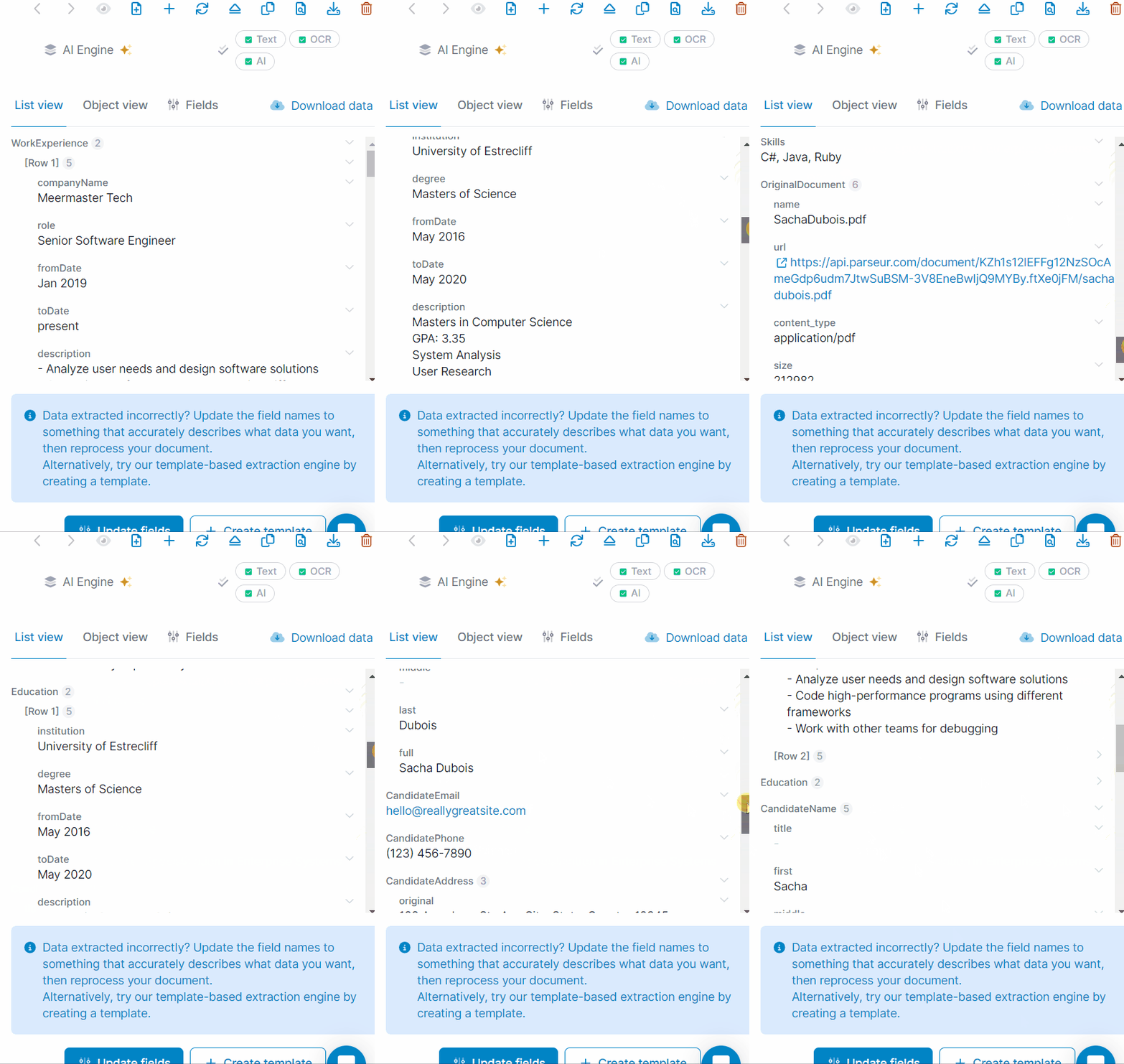
No templates to build. The AI parsing engine identifies fields by meaning, so an unfamiliar layout parses like any other, and the candidate who laid their resume out in two columns does not vanish. Which fields leave Parseur is your call, which is also how recruiting teams anonymize resumes with AI for blind screening: the name, address and school are simply never extracted.
Test it on your worst resumes, not on ours
This page just spent a section squinting at vendor accuracy claims, so apply the same squint here. The only benchmark that settles the question is your own mail: the two-column designer PDF, the copier scan an agency forwarded, the phone photograph of a printed CV. The free plan covers 20 pages a month, which is enough to push a real batch through and read the extracted fields yourself before anyone signs anything.
Setup follows the same logic. Creating the parsing mailbox and pointing a forwarding rule at it takes minutes, mapping fields to your ATS takes a little longer, and most teams have the first job running in under an hour. No implementation project, no five-month rollout.
Getting the data into your ATS
Once the fields exist, Parseur sends them wherever they need to go. Parseur connects natively to the automation platforms, not to the applicant tracking systems themselves: Zapier, Make, n8n, Power Automate and a plain webhook. Every ATS on this page publishes a create-candidate API, so that is the route into all of them, and we document the setup for Workable, Workday and BambooHR step by step. Data can also go straight to Google Sheets when a spreadsheet is the right answer.


The original resume stays attached to the record, so a recruiter checking a value opens the source document instead of trusting a field.
On the security review: documents are processed on servers in the European Union, in an ISO 27001 data center, with traffic encrypted in transit, and you stay the data controller under a DPA and the GDPR. Two things to raise with your own team before you get attached to the workflow. Certification of the data center is not the same as a vendor holding SOC 2 Type II, so ask us and every other name on your shortlist exactly what they hold. And if your policy requires US data residency, ask about it on the first call rather than the fifth.
Teams running this across the wider function pair it with the rest of their human resource automation, so resumes, job applications and staffing requests all arrive as structured records.
Keep reading
- Surviving the never-ending sea of CVs
- The evolution of resume parsing
- Best resume parsers in 2026
- Send resume data straight to Workday
Last updated on