To copy text from a PDF, open the file in a browser or PDF reader, drag your cursor across the text you want, and press Ctrl+C on Windows or Cmd+C on a Mac. On a normal PDF, that is the whole article.
Then there is the other kind. The scan where your cursor drags a blue box across the page and grabs nothing but air. The file whose author switched copying off, so Ctrl+C hands you a polite refusal. Six methods below, plus the point where copying stops being the right tool at all.
How to copy and paste text from a PDF
Six methods, roughly in the order you would reach for them. Normal PDF, start at method 1. Scan, skip to method 3. File that blocks copying, method 6.
Method 1: Adobe Acrobat Reader
Adobe Reader is Adobe's desktop app for reading and marking up PDFs, and it handles simple copying well.
- Use the mouse to click and drag over the text you want to copy.
- Right click and select "copy" or use CTRL + C (Windows) and Command + C (Mac).
- Right-click and select "Paste," or press Ctrl+V (Windows) or Cmd+V (Mac) to paste the text.

Skip the install if you would rather not bother. Drag the PDF into a Chrome, Edge, or Safari tab and select the text there, same shortcuts.
Best for grabbing a paragraph or two. Complex layouts reach the clipboard with their formatting rearranged, and scanned PDFs give you nothing at all.
Method 2: Microsoft Word
Word does not copy the text, it rebuilds the document, which is why it keeps formatting a clipboard paste would flatten. This is the method to reach for when you want to copy text from a PDF to Word.
- Open Word, click "File" then "Open," and choose your PDF.
- Click "Open." Word warns that it is about to convert the file. Let it.
- Copy the text you need out of the converted document.

Simple documents come through with most of their formatting intact.

Multi-column pages and heavily designed reports are where the conversion gets creative. Check those before you trust them.
Method 3: Google Docs
Google Docs runs OCR during the import, which makes it the shortest route to the text inside a scanned PDF. Upload the file to Google Drive first.

- Right click the document, select "Open with" and then choose "Google Docs."
- Select the text you need and paste it where you need it.

Docs reads the page and hands back an editable document. The words come across. The design does not, as the screenshot below makes painfully clear.

Method 4: Online PDF to text converters
Converters turn a whole document into plain text in one step, which is what you want when the layout does not matter. PDF to Text and PDF2Go both do the job. With PDF2Go:
- Upload the file by drag and drop, or from Google Drive or Dropbox.

- Choose your settings, click "Start," and wait for the conversion.
- Download the text file, then copy and paste what you need.
Two things to weigh before you upload. These tools run traditional OCR (optical character recognition), which reads characters without understanding what they mean, so you get text rather than usable data. And you are handing your document to a stranger's server, which deserves a second of thought when the file contains a salary, a diagnosis, or a contract.
Method 5: Python libraries
If you are comfortable with code, pypdf or the Adobe PDF Services API will do this programmatically. pypdf is an open-source Python library for reading, splitting, merging, and transforming PDF pages, and it is the maintained successor to PyPDF2. Adobe's API covers similar ground as a paid service.
One catch. pypdf reads the text layer, so a scan comes back as an empty string and a small crisis of confidence. Pair it with an OCR step for those.
Method 6: Screen text capture
Every major operating system can now lift text straight off the screen, which is the escape hatch when a PDF refuses to cooperate.
On Windows 11, open the Snipping Tool, capture the region of the page, and use Text Actions to pull out the words. On a Mac, Live Text does the same from a screenshot in Preview. On iPhone and Android, long-press the text inside a screenshot.
It works on scans and on files where selection is blocked, which is more than most methods manage. It also caps out at whatever fits on one screen. A rescue tool, not a workflow.
Why can't I copy text from this PDF?
If you cannot select text in a PDF at all, there are only two likely causes, and telling them apart takes about a second.
Your cursor draws a box over the whole page. The PDF is a scan or an image. There is no text layer, only a picture of text, so no amount of clicking will land on a word. You need OCR, which is what turns it into a searchable PDF. Google Docs, Method 3 above, is the quickest way to do it once.
Your cursor highlights words but Ctrl+C produces nothing. Copying is switched off in the file's permissions. In Acrobat Reader, right-click the page, choose Document Properties, and check the Security tab to see exactly what the author allowed. If content copying is off, the right move is to ask the sender for an unrestricted version or the password. If the document is yours, remove the restriction from that same panel.
Where copy-paste falls apart
All six methods share one ceiling, and you reach it sooner than you expect.
- Formatting rarely survives the clipboard. Fonts, sizes, and columns arrive as suggestions.
- Tables come out as a jumble, because a clipboard has no concept of rows and columns.
- Traditional OCR is accurate right up until the scan is crooked, faint, or dense.
- Online converters send your document on a round trip through someone else's server.
- Copy one digit wrong in an invoice total and you are worse off than with no data at all.
- And whatever you did copy still has to be typed or imported into the system that actually needed it.
None of that matters for one document. It matters enormously for the fiftieth one this month.
What AI reads that a clipboard cannot
AI-powered text extraction reads a document the way a person does, working out what the layout means instead of just where the ink sits. That is the difference between recovering text and getting data you can use.
Traditional OCR gives you a page of characters and leaves you to hunt for the invoice number. An AI engine returns the invoice number.
Why an AI parser handles this better
Parseur can extract specific text from PDF documents whatever the layout throws at it.
- Every supplier formats their paperwork differently. You list the fields once, and nobody builds a template per sender.
- Tables stay tables. Parseur can extract tables from PDFs as rows and columns instead of loose text.
- Scans are read on the way in, by Zonal OCR when the layout holds still and Dynamic OCR when it does not.
- Your documents stay yours. Parseur is GDPR compliant and SOC 2 Type II compliant, with the report available through the trust center.
Parseur then delivers the result into the tools you already use, so nobody copy-pastes it a second time. That is PDF parsing rather than copying, and it is a different job.
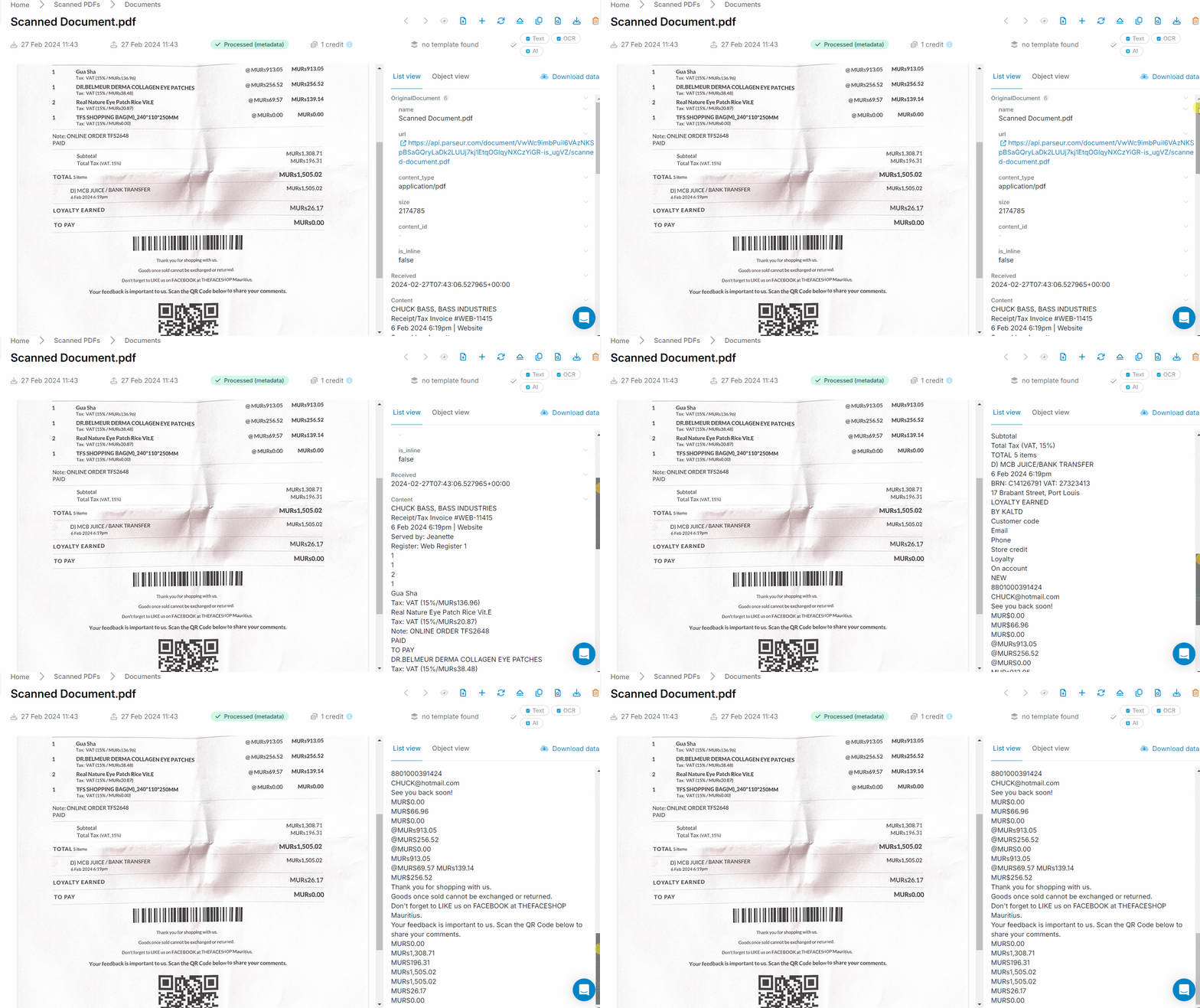
How to copy text from a scanned PDF with Parseur
Setup takes a few minutes and no credit card.
- Create a mailbox and pick the AI engine. The Vision AI engine reads PDFs, scans, and images. The Text AI engine reads emails and text documents.

- List the fields you want. The AI finds them across layouts, with no template to build.

- Send in the scanned PDF by email, upload, or API.
- Review what came back.
Working with one document type? Start from the matching mailbox and the fields come back already named. Invoices start with the "Invoices" mailbox.

Where the data goes next
- Download the text in CSV or JSON.
- Send the data to a Google Spreadsheet.
- Export it to any application using Zapier, Make, or Power Automate.
Copying text from one PDF takes two seconds. Copying it from the next five hundred is a job nobody should be given. Try Parseur on the pile you have been avoiding.

Last updated on