
PDF table extraction is the process of turning a table locked inside a PDF into structured rows and columns that software can use. It is also called extracting tabular data from a PDF. It is harder than pulling out plain text, because a PDF stores the position of every character on the page and nothing about which row or column that character belongs to. Every tool you try is guessing at a grid that was never saved.
Most of the time the guess is close enough. Then a real document lands. Line items that run onto page two. A bank statement with no ruling lines anywhere. A packing list where one description sprawls over three rows and drags the quantities out of line with it.
Why tables are the hard part of a PDF
Five things break table extraction, and they break it quietly. Nothing errors out. You just get a spreadsheet with the wrong numbers in it.
Rows that run across a page break. The table continues on page two, the header repeats, and a naive extractor calls that a brand new table. Now there is a header row sitting in the middle of your data, or the continuation is simply gone.
Merged cells. One cell spanning three rows is ordinary in a purchase order. A tool reading ruling lines sees a cell that does not fit the grid, then either duplicates the value down the column or leaves two rows blank.
Stacked or nested headers. "Q1" sitting above "Units" and "Value" means the column is Q1 Units. Flatten that into one header row and every number loses its quarter.
Then there are the tables with no borders at all. Plenty of documents separate their columns with whitespace and nothing else, so a tool keying off ruling lines has nothing to key off. Scanned pages are worse again. A photographed or scanned invoice carries no text layer, so extraction that works perfectly on a born-digital PDF hands you back an empty file.
The damage is invisible, and that is the whole problem. A failed extraction announces itself. A column that shifted by one does not. It ends up in your accounts, then in your ERP, then in a payment.
Which tables break which tools
There is no best tool to extract tables from PDF files. There is a best tool for the shape of your documents and how often they arrive.
| Approach | Works well for | Where it breaks |
|---|---|---|
| Copy and paste | One clean table, one time | Column alignment goes first, usually within seconds |
| Excel Get Data from PDF | Simple bordered tables in born-digital files | Merged cells, page breaks, anything scanned |
| Adobe Acrobat Pro | Occasional exports by one person | Accuracy drops on dense tables, and it stays a manual step |
| Tabula | Free, clean, digital PDFs you select by hand | No OCR, so no scans, and every document needs a human |
| Camelot and pdfplumber | Developers who want to tune extraction rules in Python | Code to write and maintain, and still nothing for scanned pages |
| Cloud OCR APIs | Engineering teams building their own pipeline | You are buying parts, not a workflow. Someone still has to build the intake, the review step and the export |
| AI chat assistants | Reading one document you have in front of you | Nothing runs unattended, there is no audit trail, and a human has to paste every result into its destination |
| Parseur | The same kinds of documents arriving repeatedly, going somewhere specific | A genuine one-off, where setting it up costs you more than retyping would. You also have to tell it which fields matter before the first run |
We will happily point you elsewhere. One PDF, one table, today? Tabula is free and it works. Parseur earns its keep when that table shows up again next Tuesday, and the Tuesday after that.
How to choose a PDF table extraction tool
A PDF table extractor is only as good as your worst document. If you are comparing options for a real workflow rather than a one-off, these are the questions worth asking. And do not let a vendor demo on their sample documents. Give them fifty of your ugliest ones.
- Does it read line items, or just totals? Plenty of tools hand back the invoice number and the grand total, then quietly skip the table underneath.
- Can documents arrive on their own? Email intake, a watched folder, an API. Anything that means nobody opens files by hand.
- Test a page break before you test anything else, because that is where most tools fail and not one of them warns you when they do.
- Your worst documents, not your best. Scans, borderless tables, the one supplier who insists on landscape.
- Ask where the exceptions go. Every real pipeline produces documents that need a human, and there should be a queue holding them rather than a gap in your data.
- Where does the data land? A download is not an integration. Check for the destination you actually use.
- Find out what happens when a supplier redesigns their invoice. That is the difference between a tool you set up once and a tool you maintain forever.
- Compliance answers, data residency and certifications, asked before you send anyone real invoices rather than after the first batch.
That list applies to us too. Create a mailbox, forward your twenty worst documents to it, and judge the rows that come back instead of anything written on this page. What it costs is on the pricing page, no call required to find out.
When the same tables arrive every week
Here is the split nobody making a "best table extractor" list bothers with.
Pulling a table out of a PDF you are looking at is a task. It takes a minute, and a dozen free tools do it. Pulling the tables out of four hundred supplier invoices that land by email every month, keeping every line item attached to the right row, and getting them into your ERP without anyone opening a file, is not a task. It is a process. Processes have to run when nobody is watching.
That second job is the one Parseur was built for. Documents arrive by email, upload or API. The AI engines read the fields and the line-item tables. Anything the engine is not sure about stops and waits in a review queue for a person, which is the part that matters if you have already been burned once. Nothing unchecked slips into your accounting system. Everything else goes straight to the spreadsheet, the CRM or the ledger where it was always meant to live.
Customers save up to 152 hours of data entry a month. That is not a long afternoon. That is a whole job nobody should have had.
How to extract tables from PDF documents with Parseur
Four steps, and only the first one needs you. There is no training set to assemble and no template to draw first, so document number one comes out structured the same way document number ten thousand does.
- Create a mailbox. It gets its own email address. Forward documents to it, upload them, or send them through the API.
- The AI engines read the document. PDFs, scans and images go through the Vision AI engine. Emails and text documents go through the Text AI engine. Fields and line-item tables come out structured, with no template to build first.
- Review what needs reviewing. Documents that parsed cleanly move on. The rest wait in a queue for a human to confirm.
- Send the rows where they belong. Excel, Google Sheets, a CRM, an ERP, a webhook, or any of the integrations.
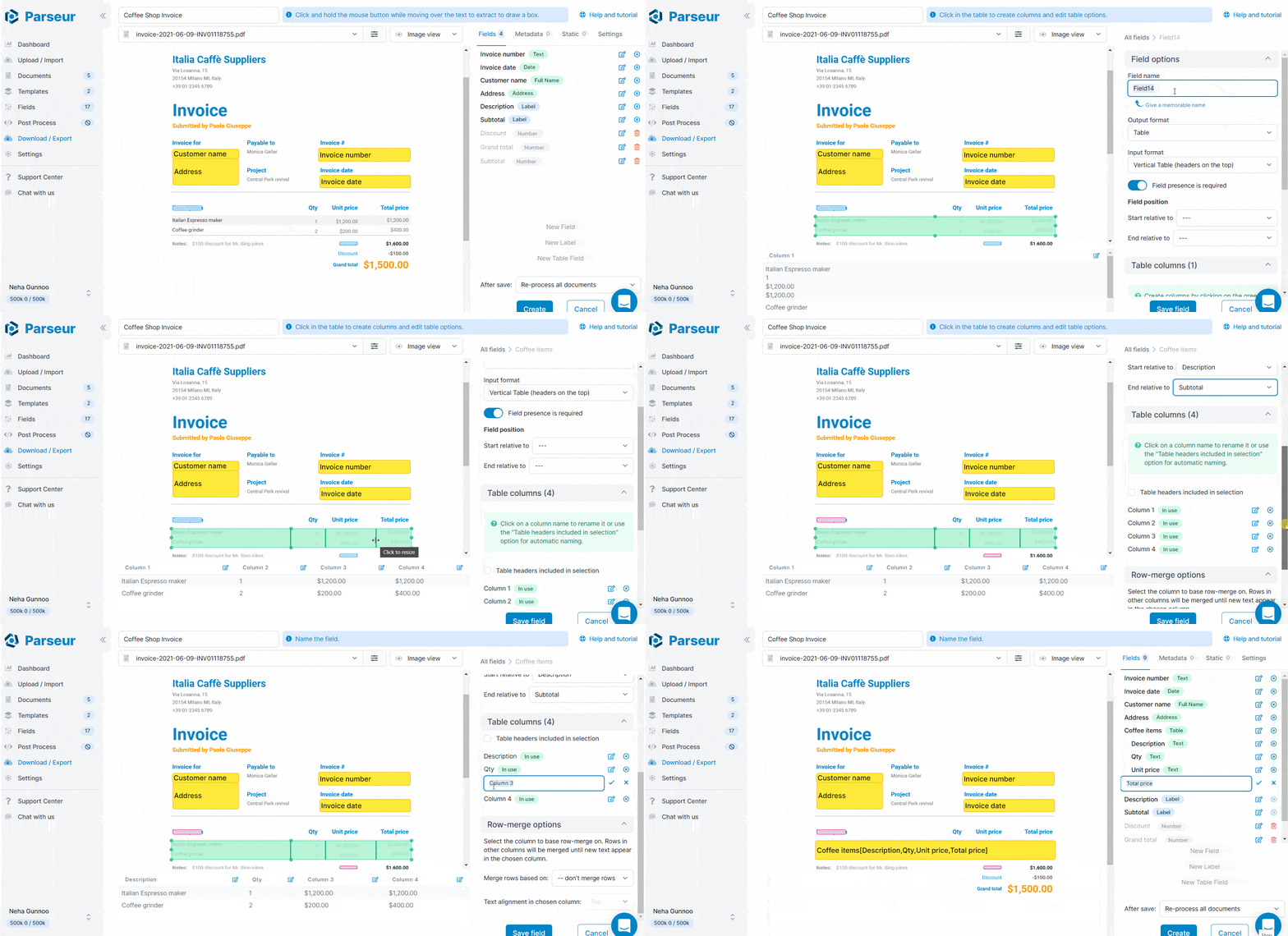
The walkthrough below covers setting up a table field end to end.
Rows leave as CSV, XLSX or JSON, go natively to Excel and Google Sheets, or reach the rest of your stack through Zapier, Power Automate and a REST API. The full list is on the integrations page.
The tables people are tired of retyping
Table extraction is rarely the goal. It is the step between a document arriving and a system being updated.
Invoices and purchase orders
The line items are the whole point. Description, quantity, unit price, extended price, one row per item, however many rows this particular supplier decided to send. Invoice data capture turns that into rows your accounts payable process can actually use, and the same data feeds accounts payable automation further down the line.
Bank statements
Almost every statement is a table, and almost none of them have borders. Reconciling by hand means walking transactions line by line against whatever your extractor produced. Bank statement extraction removes that step.
Bills of lading and packing lists
Shipping paperwork is issued as PDF, item lists included, and it arrives constantly. Automating bill of lading processing is one of the highest-volume table jobs we see.
Travel and booking confirmations
Itineraries carry flight rows, schedules and hotel bookings in table form. Pull them out and finance stops rebuilding trips from forwarded emails, and somebody can answer the question of who is currently where without asking around.
Trust, before you send us your invoices
We do not look at your data. The single exception is when you ask us to while we are helping with a support ticket. Parseur is GDPR compliant and SOC 2 Type II compliant, and the report is available on request. Documents sit on servers in the EU. Over 100 million documents have gone through the platform since 2016, and the company has been bootstrapped and profitable that whole time, so there is no investor clock forcing a change to any of that.
I love your product. I initially started with Zapier's parser, then transitioned to mailparser.io as Zapier's lacked the functionality I needed to parse table data. Unfortunately I also ran into limitations with mailparser.io, which ultimately led to my transition to your product. Mailparser.io's limitations aside, your product is better across the board, so I'm happy I made the transition.
Still weighing up options? The comparison of the best PDF parsers covers the wider field, and what PDF parsing actually is is the place to start if tables are only part of what you need out of your documents.
Last updated on


