
Every email ticketing system is good at making tickets. None of them are good at reading email.
That gap is where your agents live. Ticket opens, wall of text, scroll for the order number, copy it across, set the priority by hand, next one. Parseur closes it by reading the email first and handing your helpdesk named fields, so the ticket arrives already sorted instead of raw.
Key Takeaways
- Your helpdesk creates the ticket. It does not read it. The whole email lands in one Description field, and the interpreting is left to an agent.
- Dispatch rules, triggers and SLA clocks can only act on values. Priority, category, order ID and owner have to exist as named fields before any of them can fire.
- Parseur is the layer in front of the helpdesk, not a replacement for it. It reads the inbound email with AI, returns named fields, and passes them to Zendesk, Jira Service Management, Freshdesk, Trello or Asana.
Your Helpdesk Has One Field for the Whole Email
Most helpdesk platforms advertise email integration. What that means in practice is that the entire message gets dumped into the Description field and an agent sorts it out. Read the thread, work out what it is about, pick a tag, find the right team, assign. That is not an automated first step. That is triage, done by hand, a few hundred times a day.
The fix sits one step upstream. Parseur reads the email before it even reaches your helpdesk, extracting the information your rules need to categorize, prioritize and route the ticket automatically.
That handling time is not free. Salesforce's sixth State of Service report found that contact centre agents spend just 39% of their time actually servicing customers, with the rest going to internal meetings, administrative duties and manually logging case notes (reported by CX Today). Every field an agent retypes out of an email body comes out of that 39%.
One Email, Two Tickets
Open the ticket and the difference stops being theoretical.
Before: The standard helpdesk experience
The message body arrives as one dense block of text inside the Description field. The agent reads all of it, judges urgency, hunts for the order number, picks a category, assigns the ticket. Every agent does that slightly differently, so the queue is inconsistent by lunchtime.
After: Structured, ready-to-act tickets with Parseur
Parseur reads the email on the way in, so the ticket is created with the data already extracted and classified:
- Priority: High detected from terms like "urgent" in the subject line
- Order ID: ORD-12345 captured directly from the email body
- Category: Refund automatically classified using AI
- Assignee: Billing Team routed through automation (e.g., Zapier) based on the detected category
Nothing left to interpret. The agent opens the ticket and starts solving the problem.
What Email Ticketing Is, and Where a Parser Fits
Email ticketing is the practice of turning inbound emails into tracked, assignable tickets so that requests are worked from a queue instead of an inbox. The helpdesk owns that part: Zendesk, Freshdesk, Jira Service Management, Front, HubSpot Service Hub and the rest all convert a message into a ticket, thread the replies, and report on how long it took to close.
Parseur is not a helpdesk. It does not store tickets, assign agents or hold conversation history, and it will not replace the tool your team already lives in. It occupies the step nobody else covers well: reading the email. Parseur's Text AI engine reads emails and text documents, its Vision AI engine reads PDFs, scans and images, and both return named fields rather than raw text. Your helpdesk then receives a ticket that is already sorted.
That distinction matters because the two problems get confused constantly. If you have no ticketing system, you need a helpdesk. If you have one and your agents are still copying order numbers out of the Description field by hand, you do not need another helpdesk. You need something upstream that reads.
Which Fields Land Where
Parseur returns each piece of information as a named field, which is what makes it usable by the automation rules your helpdesk already runs. A support email about a late delivery might come back as:
{
  "order_id": "ORD-1049281",
  "customer_email": "[email protected]",
  "request_type": "late_delivery",
  "priority": "high",
  "sku": "AC-2210-BLK",
  "requested_action": "refund"
}
From there the mapping is direct:
- Zendesk: each field maps to a custom field or a tag, and triggers fire on those values to set priority and route the ticket.
- Jira Service Management: fields map to Jira custom fields and the issue type is set at creation, so the ticket is categorized properly the moment it exists.
- Freshdesk: dispatch rules run on dependable values instead of inconsistent email text, which cuts reassignment and first-response delay.
- Trello and Asana: fields become the card or task title, description, labels and assignee.
The work of connecting them is field mapping in Zapier, Make, n8n, Power Automate or a webhook, done by whoever already administers that platform. It is configuration, not engineering.
"Zendesk Already Does AI Triage"
Fair challenge, and worth settling before you look at anything else.
Native AI email triage features like Zendesk Intelligent Triage are good at classification. They read a ticket that already exists and label it: intent, language, sentiment, priority. If labels are all you need, you already have what you need, and you should not buy a second tool to get them.
What classification does not do is pull an exact value out of the body. A nine-digit order ID. A serial number. A bill rate, a start date, a SKU. Classification puts the ticket in the right bucket. Extraction fills in the fields your agent would otherwise retype. Parseur runs before the ticket exists and returns those values, which is why plenty of teams leave native classification switched on and put extraction upstream of it.
Three Requests Your Agents Retype Every Day
Inbound support looks chaotic and mostly is not. Three or four request shapes account for most of the queue, which is what makes them worth teaching a parser once rather than reading one at a time forever.
Returns and RMAs
Returns run on consistent data and customer emails supply none of it. Parse the return reason and the product SKU and the workflow starts validating itself: eligible returns approve on their own, and a human only ever sees the exceptions.
Bug reports headed for Jira
Support and QA collect bug reports by email, with the useful parts buried in prose. Parseur pulls out Steps to Reproduce, Environment and Screenshots and maps them onto Jira custom fields, so the developer opens a ticket that is already complete and nobody has to send the email asking which browser it was.
New-hire onboarding
One "new employee starts Monday" email should set off half a dozen tasks across four departments. Parseur reads the name, start date, role and location out of the message, and your automation platform opens the IT provisioning task and the HR payroll task from the same source. A chain of forwards becomes a tracked workflow.
Wiring It Into the Tools You Already Run
The fields have to land in the system your team actually works in, shaped the way that system's automation expects. Parseur sits between the inbound email and your stack and gives each tool what it runs on.
Jira Service Management gets the issue type right
With Jira Service Management, most of the value sits in accurate custom fields and the correct issue type. Parseur maps details out of the email straight onto those fields, so tickets are categorized properly the moment they are created and engineering prioritizes off data it can trust.
Zendesk tags that mean something
Zendesk routing lives on tags and triggers, and both are only as good as whatever set them. Extract intent, urgency and context before the ticket exists and the tagging comes out the same every time, with no agent in the loop. Your triggers fire on arrival rather than after someone has finally read the message.
Freshdesk dispatch rules deserve better input
Feed Freshdesk dispatch rules named fields instead of inconsistent email text and tickets reach the right team on the first hop. The Freshdesk integration walks through the field mapping.
MSP service desks and ConnectWise
Managed service providers take in requests from dozens of client domains, each writing them a different way. Parseur reads the request whatever shape it arrives in and hands over the fields, so tickets are created in ConnectWise with the client, the affected system and the urgency already set.
Trello and Asana, when it is not really a ticket
Plenty of inbound work is not support work. Operations teams run it in Trello or Asana, where speed matters more than process, and Parseur hands them a Trello card or Asana task that turns up populated instead of empty.
Bug reports that arrive as Linear issues
Linear is where a lot of product and engineering teams now track their work. When a bug report or feature request comes in by email, Parseur extracts the details and the issue is created with the right title, description, priority and label.
What Your Procurement Team Will Ask
Three questions come up every time, usually before anyone has watched a demo.
What does it cost at our volume? Parseur is priced per page processed, not per agent seat, and an email counts as one page whatever its length. You pay for the mail, not for the people reading it. The free plan runs 20 pages a month with no credit card, entry plans cover up to 3,000 pages a month, and volume plans run to a million.
What happens to our customers' data? Parseur is SOC 2 Type II compliant and pen tested by an external security firm, and Scale and Enterprise customers can request both reports. Retention is yours to set per mailbox, from one day upward, so support mail does not have to live in Parseur after your helpdesk has the fields.
How soon is it doing something useful? Forward one real support email and the fields come back the same minute. The work after that is mapping those fields onto your helpdesk inside whichever automation platform your admins already run, which is configuration in a tool they have, not an engineering project.
How to Set Up Email Ticketing With Parseur
Step 1: Create your Parseur mailbox
Parseur is free to start with, and the free plan includes all features: 20 pages a month, no credit card.
Pick Custom emails, or Custom emails and attachments if support requests arrive with PDFs, screenshots or scans attached.
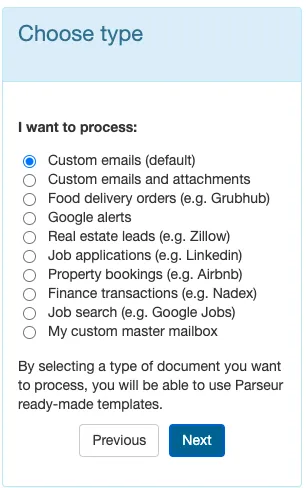
Once your mailbox is created, you get an email address to forward support mail to.
Step 2: Forward your support address
Emails arrive in seconds. Most teams set an auto-forwarding rule on the shared support inbox, so nobody has to forward anything by hand.

Step 3: Let the AI engine read it and name your fields
There is no template to build. Parseur's AI parsing engine reads the email and returns the fields you asked for: order ID, request type, priority, SKU, environment, whatever your queue runs on. The Text AI engine handles email bodies and text documents. The Vision AI engine handles PDFs, scans and images. A customer who writes three paragraphs and a supplier who attaches a PDF come back as the same field list.
When accuracy matters more than throughput, turn on validation. You set a confidence threshold. Anything below it waits in a review queue for a human to confirm or correct, and everything above it flows straight through. One person spot-checking the uncertain few beats the whole team retyping the certain many.
Step 4: Send the fields to your helpdesk
Export the parsed fields in real time through Zapier, Make, n8n, Power Automate, a webhook or the API. That step creates or updates the ticket, and your existing triggers and dispatch rules take it from there.

Your helpdesk keeps doing what it is good at. Your agents stop doing the part it was never good at.
Last updated on