
Every job posting is a company admitting in public that it has a problem and the budget to fix it. The US alone had 7.4 million job openings on the last business day of June 2026. A slice of those are your next clients, and they are already arriving in your inbox as LinkedIn alerts, Indeed digests and Google Jobs notifications. Most teams skim them over coffee and forget them by lunch. Parseur reads them properly, pulls out the company, the role and the location, and files them as structured leads while your competitor is still scrolling.
Key Takeaways
- Every job posting declares a need, a budget and a direction. Reading them one at a time does not scale past a handful a day.
- Scraping is the wrong tool for it. It breaks on every layout change, it puts you the wrong side of the platform's terms, and the same data is already being mailed to you on purpose.
- Parseur parses job alert emails into structured fields and drops them into a spreadsheet, Slack or your own endpoint. Zapier, Make, n8n or Power Automate carries them the last step into a CRM, and a noisy inbox turns into a hiring-signal pipeline.
What does it mean to parse job alert emails?
To parse job alert emails is to extract each posting's details from the notification a job board sends you and return them as structured fields instead of a wall of HTML. From a LinkedIn, Indeed, Glassdoor or Google Jobs alert, Parseur returns the company name, job title, location, posting date, posting URL, department or seniority level, and salary where the board publishes it, one row per role, ready for a spreadsheet or a CRM.
Nothing is scraped. The email was sent to you deliberately, by the platform, in a format the platform maintains itself. That is the whole trick, and it is why the pipeline survives redesigns that break browser extensions overnight.
Why a job posting is a buying signal
For a recruitment agency or a B2B sales team, a new job posting is not a role to fill. It is a tell.
A company hiring a VP of Sales is planning a bigger number next year. Five engineering roles at once usually means something has already been sold or funded that nobody has staffed yet. Growth costs money, and a company that is growing buys software, vendors and partners to do it. All of that gets announced in public, for free, weeks before anyone opens a cold email.
For headhunters, staffing agencies and B2B SDRs, that same posting is a lead that has already qualified itself. The need is admitted. The budget exists. The only open question is who reaches the hiring manager first.
Finding the signal was never the hard part. Keeping up with it was: three boards checked by hand, company names copied into a spreadsheet, CRM records updated one at a time. Work that is inconsistent on a good week and quietly abandoned on a busy one.
How to parse job alert emails in three steps
Monitoring job boards by hand does not scale. Letting the alerts do the monitoring, and Parseur do the typing, does. Setup is one forwarding rule and a list of field names, and there is no template to build.
1. Set the alerts
Create job alerts on LinkedIn, Indeed or Google Jobs using the keywords that define your market:
- "Hiring CTO"
- "VP of Sales"
- "Head of Marketing"
- "Series A startup hiring"
This is the one part of the workflow the job boards actively want you to use.
2. Forward them to your Parseur mailbox
Add an auto-forwarding rule so those alert emails land in your Parseur mailbox instead of your attention. Automatic forwarding takes a minute to set up and then never needs touching again.

3. Let the AI engines read them
Parseur's Text AI engine reads the alert emails. The Vision AI engine handles anything that arrives as a PDF or an image attachment. Neither one needs a template built per board, which is what used to make this kind of automation so fragile. Name the fields you want. They come back filled.
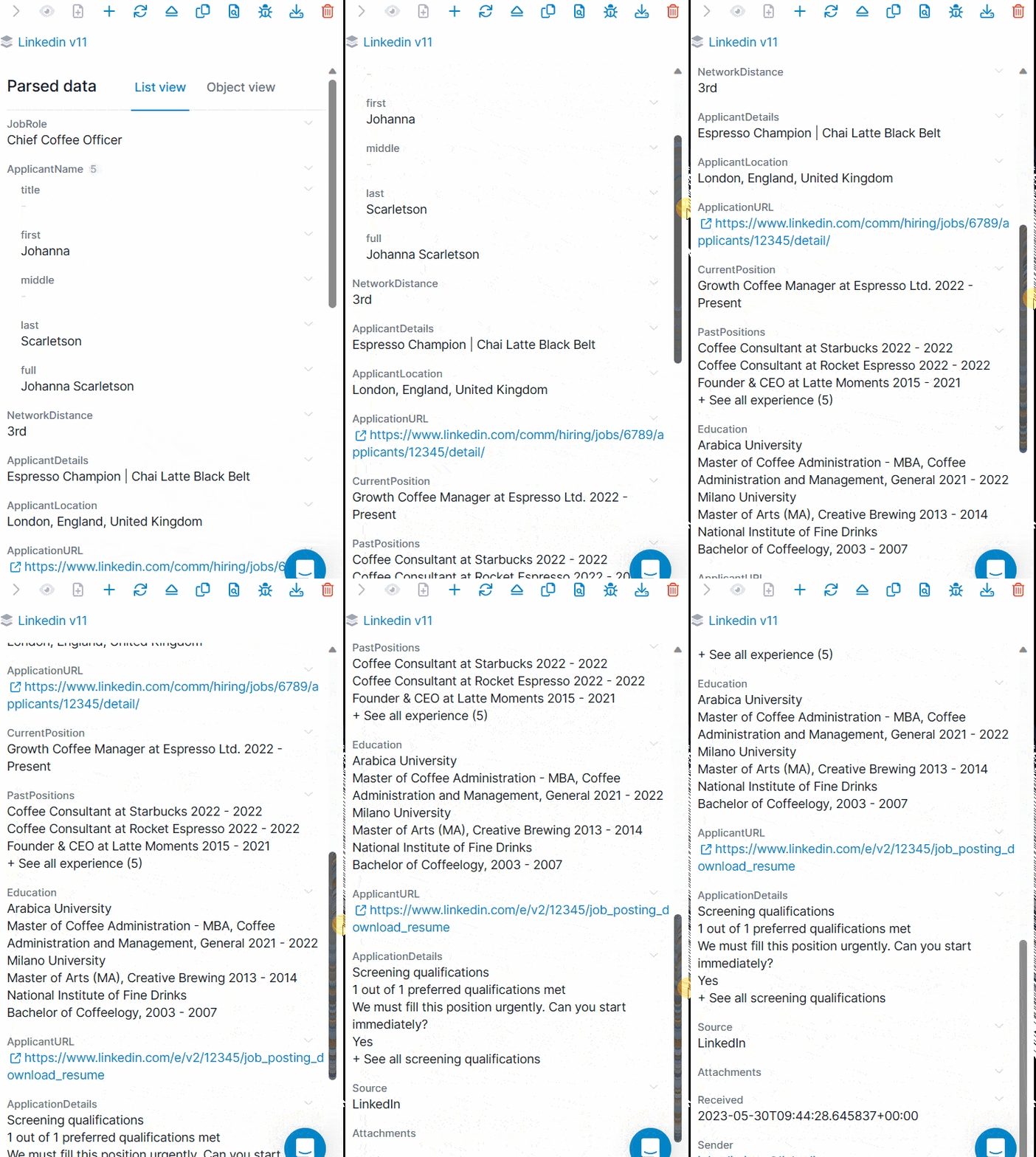
Alerts do not arrive tidy. LinkedIn bundles several roles into one digest, Indeed sends a layout of its own, and every board redesigns on its own schedule. The engines read all of them without a per-board setup, and a digest carrying six roles comes back as six rows.
By the end of the first week you have a searchable list of every company in your market that is hiring, updated the second an alert lands.
What teams actually do with the parsed rows
Hiring intent has a shelf life. Every day a posting stays open, somebody else is calling the same hiring manager, which is why the fifteen minutes of admin this saves matters less than the head start it buys.
Recruitment lead generation
For a staffing agency, a posting is a warm lead with a clock on it. A company advertising "Senior Backend Engineer" or "VP of Sales" has already agreed internally that it needs help, and whoever calls first usually runs the search.
The pipeline runs like this:
- Job alert emails are parsed on arrival.
- Company names and roles come out as fields.
- An automation step sends them to an enrichment tool such as Apollo.io or Clearbit.
- Founder, CEO or hiring-manager contact details come back attached to the record.
Your recruiters start the conversation instead of starting the research. And once those conversations turn into orders, the same mailbox reads those too, with job order automation.
Competitor intelligence
Job postings leak strategy. Five account executives in a new region is expansion. A sudden run on AI engineers is a product shift. A first Head of Compliance usually means somebody upstairs has promised an enterprise customer something.
Set alerts on the names you care about, let Parseur pull the titles and locations, and route the rows into a Slack channel or an internal dashboard. Leadership gets a standing view of who is building what, and nobody has to be the person assigned to watch job boards.
B2B software sales targeting
If you sell HR software, a prospect posting People Operations Manager is telling you the budget cleared. Four SDR openings at once says the same thing to anyone selling sales enablement, only louder.
Pull the companies hiring for the roles that map to your product, push them into your CRM, and open with the hire itself rather than a template. That is intent-based selling, with the intent supplied free, in public, by the prospect.
Why parsing beats scraping
The instinct, when a team wants job data at scale, is to scrape the boards. It sounds direct. It rarely survives contact with production.
The problem with scraping
- It usually violates the platform's terms of service.
- IP bans arrive within days, and then you are shopping for rotating proxies.
- One renamed CSS class takes the whole pipeline down overnight.
- CAPTCHA and bot detection catch up eventually.
- Someone has to be on call the night it dies.
For an agency or an SDR team, none of that shows up as a line item on a budget. It shows up as the hours nobody spent selling.
The email alternative
Every major job platform already sends structured alert emails. They are official, consistently formatted, delivered to an inbox you control, and built to be read. Parsing the notification a platform sent you is a fundamentally different act from scraping a site that never invited you, and it removes the proxies, the bans, the CAPTCHAs and the terms-of-service exposure in one move.

Nothing to babysit at 2am. You are working inside the notification channel the platform maintains for you, which is exactly why the pipeline holds when the website underneath it changes.
Where the parsed data goes
Parseur is the intake layer. It does not replace your stack, it feeds it.
Natively, parsed rows go to Google Sheets, Microsoft Excel, Slack, or straight to your own endpoint through a webhook or the API.
Through an automation platform, they reach everything else. Zapier, Make, n8n and Power Automate pick up the fields Parseur extracted and create the record in Salesforce, HubSpot, Airtable, Bullhorn, Pipedrive or wherever your team actually lives. Parseur is not pretending to be a CRM connector. It extracts, the automation step delivers, and nobody types.
Job alerts sometimes name a recruiter, and recruitment data is regulated. Parseur is GDPR compliant and SOC 2 Type II compliant, with the report available on request, and you set how long parsed rows are kept before they are deleted.
Airtable as a hiring intelligence base
Rows landing in Airtable become a live database of companies hiring in your market, filterable by role, department or geography and taggable against your ICP. Track it for a few months and it stops being a spreadsheet and starts being a private map of where your market is spending its money, which is not something anyone can buy off the shelf.
CRM records that create themselves
With the automation wired up, a target company posting a relevant role can open an account, generate a lead assigned to a rep, attach the job title and posting URL to the record, and trigger the follow-up task. Nobody opens the CRM to log the lead, because the lead logged itself.
Job posted, alert received, fields parsed, record created, outreach triggered. The difference between an inbox and a pipeline is whether anything reads it.
What it costs to find out
Parseur charges for pages processed each month, not for seats, so a busy hiring quarter only costs more in the quarter it happens. An email counts as one page whatever its length, which means one alert is one credit even when it carries six roles. The free plan covers 20 pages a month, enough to run a real week of your own alerts through it and read the extracted fields yourself before anyone signs anything.
Looking for a job rather than for leads?
Same mechanism, other side of the table. If you are the one applying, Parseur turns those alerts into a self-updating application tracker instead of an inbox you avoid opening. That workflow has its own guide: automate your job search with Parseur.
Last updated on