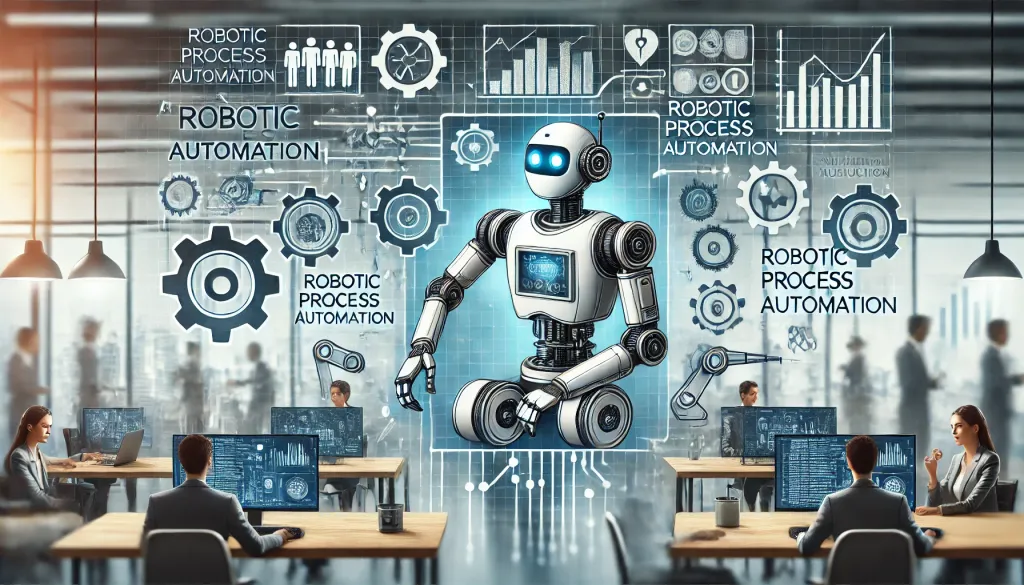
Business automation has evolved from RPA to hyperautomation, where AI-driven workflows run end-to-end with minimal manual effort. Because most processes begin with documents, turning unstructured data into reliable structured inputs is the first critical step toward true hyperautomation.
Key Takeaways
- Automation has evolved from task-level RPA to intelligent, end-to-end hyperautomation, driven by AI, document understanding, and process orchestration.
- Generative AI enables context-aware decisions, exception handling, and adaptive workflows, turning rigid automation into a flexible one that can grow with demand.
- Reliable structured data is the foundation of hyperautomation, and platforms like Parseur help transform real-world documents into trusted inputs that intelligent workflows can act on.
Why Automation Is Moving Beyond RPA to Hyperautomation
Robotic Process Automation (RPA) was supposed to eliminate manual work. Instead, many organizations ended up with brittle bots that break whenever a website changes, a field moves, or a vendor updates an invoice layout. What began as a promising shortcut to efficiency often created a new maintenance burden, one in which teams spend as much time fixing automation as they once spent doing the work themselves.
This gap between promise and reality has pushed automation to evolve. Early rule-based scripts gave way to AI-assisted tools, which are now expanding into a broader approach: hyperautomation. Rather than automating isolated tasks, hyperautomation connects multiple technologies, such as AI, machine learning, RPA, and intelligent document processing, into coordinated systems that can manage complete workflows from start to finish.
The timing matters. Recent advances in generative AI have dramatically expanded what software can understand, decide, and execute. Processes that once required rigid rules can now adapt to variation, unstructured data, and changing business conditions. For organizations under pressure to scale operations without scaling headcount, this shift is more than technical progress. It's an operational turning point.
Hyperautomation is the orchestrated use of multiple technologies (AI, ML, RPA, IDP, and process mining) to automate complex, end-to-end business processes that adapt and improve over time.
Understanding how automation reached this stage and what comes next helps explain why the conversation is moving beyond RPA toward fully intelligent business operations.
The RPA Era: Promise vs. Reality
When Robotic Process Automation (RPA) emerged in the mid-2010s, it promised to offload repetitive, rule-based work from humans to software "bots." By simulating user interactions and handling structured data, RPA enabled accelerated back-office tasks, reduced errors, and freed up teams for higher-value work. Between 2015 and 2020, the RPA market transitioned from a niche technology into one of the fastest-growing categories in enterprise software, driven by organizations seeking cost savings and operational efficiency.
During this period, the global RPA market expanded from approximately $271 million in 2016 to nearly $2 billion by 2020/2021, sustaining an estimated compound annual growth rate (CAGR) between 21% and 36% depending on whether services were included. By the end of 2020, around 20% of businesses had implemented RPA solutions, with adoption accelerating further among large enterprises in the years that followed.
What RPA actually delivered was valuable in many predictable, high-volume scenarios. Bots could automate tasks where inputs and systems were stable: copying fields from one database into another, entering standardized transaction records, or triggering simple workflows. In areas like data entry and invoice processing, RPA helped reduce error rates and processing times. Companies deploying RPA can expect a potential ROI of 30% to 200% in the first year.
What this means in practice is constant firefighting instead of scaling automation. Teams spend an outsized amount of time fixing brittle scripts. What looked like a way to eliminate manual work ends up creating a maintenance treadmill that slows teams down and uses up the very capacity automation was supposed to free.
Where Traditional RPA Falls Short
Despite its early promise, traditional RPA comes with significant limitations that organizations quickly encounter.
The Brittleness Problem
RPA bots excel when processes are predictable, but even minor changes can break automation. A simple update to a web interface, a new field in an enterprise application, or a vendor changing an invoice template can halt a bot in its tracks. They cannot reason through exceptions and require constant maintenance. This fragility contributes to a well-documented scaling challenge. According to Ernst and Young, up to 50% of RPA projects fail to move beyond pilot or limited deployments, leaving teams trapped in ongoing upkeep rather than realizing strategic automation benefits.
The Unstructured Data Wall
Traditional bots depend on structured data. Emails, PDFs, scanned documents, and other unstructured inputs create friction for RPA, as each variation often requires a separate template or manual preprocessing. For example, an invoice-processing bot might run perfectly for three vendors but fail when a fourth vendor uses a slightly different format. Without a way to intelligently understand documents, RPA document processing stalls, leaving humans to intervene frequently.
The Exception Handling Gap
Rule-based bots cannot handle edge cases. Missing fields, unexpected sequences, or unusual data entries automatically escalate to human intervention. Over time, these exceptions build up, creating queues and bottlenecks that undermine the productivity gains RPA promised.
Hidden Costs
The limitations of RPA translate directly into hidden operational costs:
- Bot maintenance overhead: Teams must dedicate engineering resources to fixing broken scripts.
- Exception handling queues: Humans are needed to resolve cases that bots cannot manage.
- Limited scalability: Because bots fail under variation, organizations struggle to expand automation across end-to-end workflows.
In practice, these challenges mean that while RPA can deliver short-term efficiency for highly repetitive, structured tasks, it often creates a new layer of operational complexity that constrains growth and delays broader automation initiatives.
The Bridge Technologies: IDP and Process Mining
As organizations grappled with the limitations of traditional RPA, two technologies emerged to fill critical gaps: Intelligent Document Processing (IDP) and process mining. While RPA excelled at structured, repetitive tasks, it struggled with unstructured inputs and understanding real-world workflows. These bridge technologies set the stage for more intelligent, adaptable automation, but they were not the full solution on their own.
Intelligent Document Processing (IDP)
IDP addresses one of RPA's most persistent pain points: unstructured documents. Whereas traditional bots rely on rigid templates and predefined fields, IDP uses machine learning to extract data from emails, PDFs, scanned forms, and documents with varying formats. Rather than simply reading a fixed position on a page, IDP understands context, recognizes semantics, and can adapt when layouts change.
This enables scaling tasks that were previously brittle under RPA. For example, invoice processing can now handle dozens of vendors without creating a new template for each one. ML-based extraction enables continuous learning: the system improves accuracy over time as it encounters new formats or exceptions, dramatically reducing the need for human intervention.
The real value of IDP isn't just speed. It's reliability at scale. By converting messy, unstructured data into structured, machine-readable outputs, IDP creates a foundation that automation systems can trust, reducing downstream errors and maintenance overhead.
Process Mining and Discovery
While IDP focuses on inputs, process mining focuses on understanding the workflow itself. It captures actual operational data from system logs, event streams, and transaction histories to visualize how work flows in reality, rather than how it was intended on paper.

Process mining helps identify bottlenecks, redundancies, and high-impact automation opportunities. For instance, it can reveal that invoice approvals are routinely delayed by one step, or that a specific routing path consumes disproportionate human effort. These insights allow teams to prioritize automation where it will deliver the greatest return.
Why These Technologies Alone Were Not Enough
Despite their power, IDP and process mining were point solutions rather than complete automation platforms. IDP can process complex documents, but it doesn't orchestrate multi-step workflows across systems. Process mining uncovers inefficiencies, but it doesn't execute tasks autonomously. Each technology also requires domain-specific expertise: ML model tuning for IDP or workflow analysis for process mining, making adoption slower and more fragmented.
In essence, these technologies solved pieces of the puzzle, but organizations still needed orchestration, decision-making, and end-to-end automation. That gap would eventually be addressed by the next evolution: hyperautomation, where RPA, IDP, process mining, and AI combine into intelligent, adaptive business workflows.
Enter Generative AI: The Intelligence Layer
What changed with generative AI is not that machines automate tasks faster, but that they understand and reason about information in ways previous generations of automation simply could not. Traditional automation, including rules-based RPA and early machine learning systems, depends on structured inputs, predefined patterns, and brittle templates. In contrast, generative AI models excel at natural language understanding, context-aware reasoning, and interpreting ambiguity across formats and workflows. These capabilities have reshaped expectations for what intelligent automation can do.
The pace of adoption reflects this shift. Across industry surveys, generative AI usage has climbed sharply. As of late 2025, 82% of enterprise leaders report using GenAI at least weekly, and 46% say they use it daily for business tasks and decision support, up dramatically from earlier years as tools move from experimentation into everyday workflows.
In professional services specifically, organizational adoption of GenAI has nearly doubled over the past year, rising from about 12% in 2024 to 22% in 2025, showing clear momentum as firms expand use cases beyond pilots into real work.
These figures highlight a transition from early experimentation to active operational use. Unlike traditional machine learning, which often requires retraining for new document layouts or evolving workflows, generative AI adapts more fluidly to changing contexts and language patterns without explicit retraining, making it particularly well-suited for complex, unstructured automation scenarios. This adaptability underpins its value as the intelligence layer in modern hyperautomation.
Natural Language at Scale
One of generative AI's most transformative capabilities is its ability to interpret and act on natural language across varied sources. Where legacy systems rely on rigid fields, generative AI can:
- Understand the intent behind an email and route it appropriately
- Classify customer inquiries with nuance rather than keyword matches
- Summarize long documents into actionable insights
For example, customer service automation fueled by generative AI can interpret the intent and sentiment of incoming support emails, escalate critical issues, and draft responses that reflect context far beyond what simple rules or regex patterns can achieve. This moves organizations from mechanistic triage to genuinely responsive workflows that more closely mimic human reasoning.
Intelligent Exception Handling
Traditional automation stumbles when it encounters edge cases, those inputs or scenarios that don't match the script. Generative AI brings a new dimension: contextual reasoning that helps automate decisions even when the data isn't perfect. Rather than failing outright or escalating every anomaly to a human, AI agents can explain their reasoning, provide confidence estimates, and flag items for review when appropriate.
Consider an expense report with unusual charges: instead of merely rejecting it or routing it to a human reviewer, a GenAI-powered workflow can assess policy context, industry norms, and past precedents to make an informed recommendation, reducing exception queues and focusing human attention where it matters most.
Cross-Document Intelligence
Generative AI bridges silos by connecting insights across multiple sources. Where earlier systems extracted data from one document at a time, generative models can correlate information across applications, statements, contracts, and communications. In loan processing, for example, AI can pull relevant details from an application, tax returns, bank statements, and employment records, reconcile inconsistencies, and surface a unified view for decisioning without forcing rigid preformats.
This cross-document intelligence dramatically increases both throughput and trust in automated workflows.
Adaptive Learning Over Time
Another advantage is adaptive learning. Instead of rigid rulesets that break with every change, generative AI systems continuously improve as they encounter new inputs and receive feedback. They recognize patterns, detect anomalies, and fine-tune outputs without costly model retraining. This results in more resilient automation that learns from real-world use rather than stagnating after deployment.
Together, these capabilities make generative AI the intelligence layer that turns isolated automation tasks into adaptive, context-aware, end-to-end business process automation, paving the way for the next evolution in hyperautomation.
Hyperautomation Defined: The Complete Picture
As automation matured, organizations began to push beyond task-by-task bots toward a more strategic concept: hyperautomation. Coined and popularized by Gartner, hyperautomation describes a disciplined, business-driven approach that uses multiple technologies in concert to find, orchestrate, and automate as many business and IT processes as possible. It isn't one tool. It's an ecosystem of tools and intelligence that supports end-to-end automation rather than isolated task automation.
In practice, hyperautomation brings together several core technologies:
- AI and Machine Learning (ML) for contextual decisions and pattern recognition
- Intelligent Document Processing (IDP) to convert unstructured inputs into structured data
- Robotic Process Automation (RPA) for task execution across systems
- Process orchestration for workflow coordination
- Analytics and process insight for continuous optimization
- Low-code/no-code tooling to make automation accessible to business users
Rather than relying on stand-alone bots or scripts, hyperautomation layers technologies so that each part complements the others: document inputs are intelligently parsed, workflows are mapped and monitored, decisions are made with context, actions are executed reliably, and the system grows with demand.
RPA vs. Hyperautomation: Key Differences
| Aspect | Traditional RPA | Hyperautomation |
|---|---|---|
| Scope | Task-level automation | End-to-end process automation |
| Data Handling | Structured only | Structured + unstructured (via IDP/AI) |
| Exception Handling | Manual escalations | Intelligent exception resolution |
| Scalability | Limited | Grows broadly with orchestration |
| Maintenance | High | Lower with adaptive learning |
| Learning Capability | None | AI/ML-enabled |
| Decision Making | Rule-based | Contextual and data-driven |
| Implementation Complexity | Simple | Higher (multi-technology) |
| Best For | Repetitive tasks | Complex business workflows and adaptive processes |
Order-to-Cash (O2C) Process
In a traditional RPA setup, order-to-cash automation might launch separate bots for order entry, credit checks, inventory lookups, shipping notifications, and invoicing. Each bot works in isolation, and handoffs between them often rely on rigid formats and structured inputs. If a customer submits an order via a new channel, say email with a PDF, a web form with attachments, or a scanned fax, the system breaks, requiring human catch-ups and manual interventions.
With hyperautomation, the O2C flow becomes truly end-to-end. Incoming orders from email, EDI, web portals, or scanned documents first pass through an IDP layer, which extracts structured data regardless of vendor format. A Generative AI layer interprets customer intent, flags special requests, and verifies orders against contracts or inventory rules. Next, an RPA layer executes tasks across ERP, CRM, warehouse management, and billing systems. A central orchestration and analytics engine coordinates the workflow, handles exceptions smartly, and identifies process bottlenecks in real time.
The result is dramatic: order processing times collapse from hours to minutes, error rates drop below 1%, and manual intervention becomes rare rather than routine. Data flows smoothly across systems, and teams can focus attention on exceptions that truly require human judgment.
Procure-to-Pay (P2P) with Intelligent Three-Way Matching
In many organizations, P2P automation begins with RPA bots that enter invoice data into an ERP. These bots are fragile: they break when formats vary and can't reconcile discrepancies between purchase orders, receipts, and invoices. Exception rates of 20-40% are common, forcing finance teams into manual review loops that erode automation benefits.
Hyperautomation changes that dynamic. An IDP layer ingests invoices in any format, PDF, email, scanned, or portal screenshot, extracting accurate line items, totals, and references. A Generative AI layer then performs intelligent three-way matching: it understands tolerance levels for quantity variances, price differences, and shipment exceptions. When ambiguity arises, the system reasons about likely causes and can even initiate vendor communication for clarification.
Behind the scenes, RPA executes updates to ERP systems, triggers payments, and archives documentation. A process mining component continuously analyzes patterns to uncover vendor behaviors or optimization opportunities.
The outcome is measurable: invoice processing costs fall significantly, payment cycles shorten, early-payment discounts are captured more often, and exception rates drop from a third of invoices to a fraction.
Implementation Roadmap: Getting to Hyperautomation
For most organizations, hyperautomation doesn't arrive all at once. It emerges through a gradual progression of capabilities, each building on the reliability and lessons of the previous stage. Understanding this maturity path helps teams move forward deliberately, avoiding both over-engineering and stalled experimentation.

Level 1: Task Automation
The journey typically begins with basic RPA. At this stage, organizations roll out single-purpose bots to automate repetitive, rules-based tasks such as data entry, report generation, or system updates.
These early wins demonstrate clear efficiency gains and help justify further investment. However, automation remains fragmented. Bots operate in isolation, depend heavily on structured inputs, and require manual oversight when exceptions occur. While valuable, task automation alone rarely transforms end-to-end operations.
Level 2: Process Automation
The next step is to connect individual automations into coordinated workflows. Instead of isolated bots, organizations begin orchestrating multi-step processes, often introducing Intelligent Document Processing (IDP) to handle emails, PDFs, and scanned inputs that traditional RPA cannot manage reliably.
At this level, automation becomes more operationally meaningful. Processes such as invoice handling, order intake, or onboarding start to flow across systems with reduced manual intervention. Still, decision-making remains largely rule-based, and exception handling often falls back to humans.
Level 3: Intelligent Automation
With the addition of AI-driven reasoning, automation shifts from scripted execution to context-aware decision making. Machine learning and generative AI enable systems to interpret ambiguous inputs, classify requests, explain outcomes, and manage many edge cases without predefined rules.
This stage significantly reduces exception queues and improves accuracy across variable data sources. Automation begins to feel adaptive rather than rigid, though orchestration and optimization may still require human configuration and monitoring.
Level 4: Hyperautomation
True hyperautomation emerges when intelligence, execution, and orchestration work together across the entire business process. AI and ML provide reasoning, IDP structures incoming data, RPA executes system actions, and orchestration layers coordinate workflows end-to-end.
Equally important, analytics and process mining introduce continuous visibility, revealing bottlenecks, predicting delays, and enabling ongoing optimization. Automation is no longer a collection of tools. It becomes an operational infrastructure that scales with the business.
At this stage, organizations achieve meaningful outcomes:
- End-to-end workflow automation rather than task automation
- Dramatically reduced manual intervention
- Greater resilience to changing formats, volumes, and conditions
- Measurable improvements in speed, accuracy, and cost efficiency
Level 5: Autonomous Agents
The final stage extends hyperautomation into goal-oriented autonomy. Instead of executing predefined workflows, AI agents can plan actions, adapt to changing objectives, and coordinate across systems with minimal human direction.
Humans remain essential, but their role shifts toward governance, strategy, and exception oversight rather than routine execution. Automation becomes not just a productivity tool, but a digital operational partner capable of continuous improvement.
Moving Forward with Intent
Progressing through these maturity levels is less about adopting a single technology and more about building a reliable foundation. Organizations that succeed typically:
- Start with high-volume, well-defined processes
- Introduce structured data extraction early
- Layer intelligence only after reliability is proven
- Invest in visibility, monitoring, and governance
Hyperautomation is ultimately a journey of trust. Each stage reduces uncertainty, expands capability, and prepares the organization for the next level of autonomy, turning incremental automation into lasting operational transformation.
From Task Automation to Intelligent Operations
Automation is no longer just a tool for efficiency. It is becoming a foundation for how modern organizations operate, make decisions, and scale. What started as isolated efforts to reduce manual work has steadily evolved into connected, intelligent systems capable of understanding information, adapting to change, and executing complex processes with minimal human intervention. This shift marks a turning point not only in technology but in how businesses design and trust their operational workflows.
The evolution of business automation tells a clear story. What began with RPA automating individual tasks expanded through intelligent document processing that unlocked unstructured data, accelerated further with generative AI adding reasoning and context, and ultimately converged into hyperautomation: end-to-end systems capable of orchestrating entire workflows. Today, the path is already extending toward autonomous agents that operate with goals, adaptability, and continuous learning.
This progression reflects a deeper shift. Organizations are no longer focused only on automating effort. They are beginning to automate intelligence itself, how information is understood, decisions are made, and actions are executed across complex operations.
Importantly, this is not distant future thinking. Many of these capabilities are already in production across finance, operations, logistics, and customer workflows. The question is no longer if automation will evolve, but how quickly organizations can build the right foundation to benefit from it.
For most businesses, that foundation starts with documents. Emails, PDFs, invoices, and forms still initiate a large share of operational processes. Turning this unstructured input into reliable, structured data is often the first practical step toward true hyperautomation. See how Parseur can serve as a foundation for hyperautomation and what that could look like inside your own operations.
Last updated on